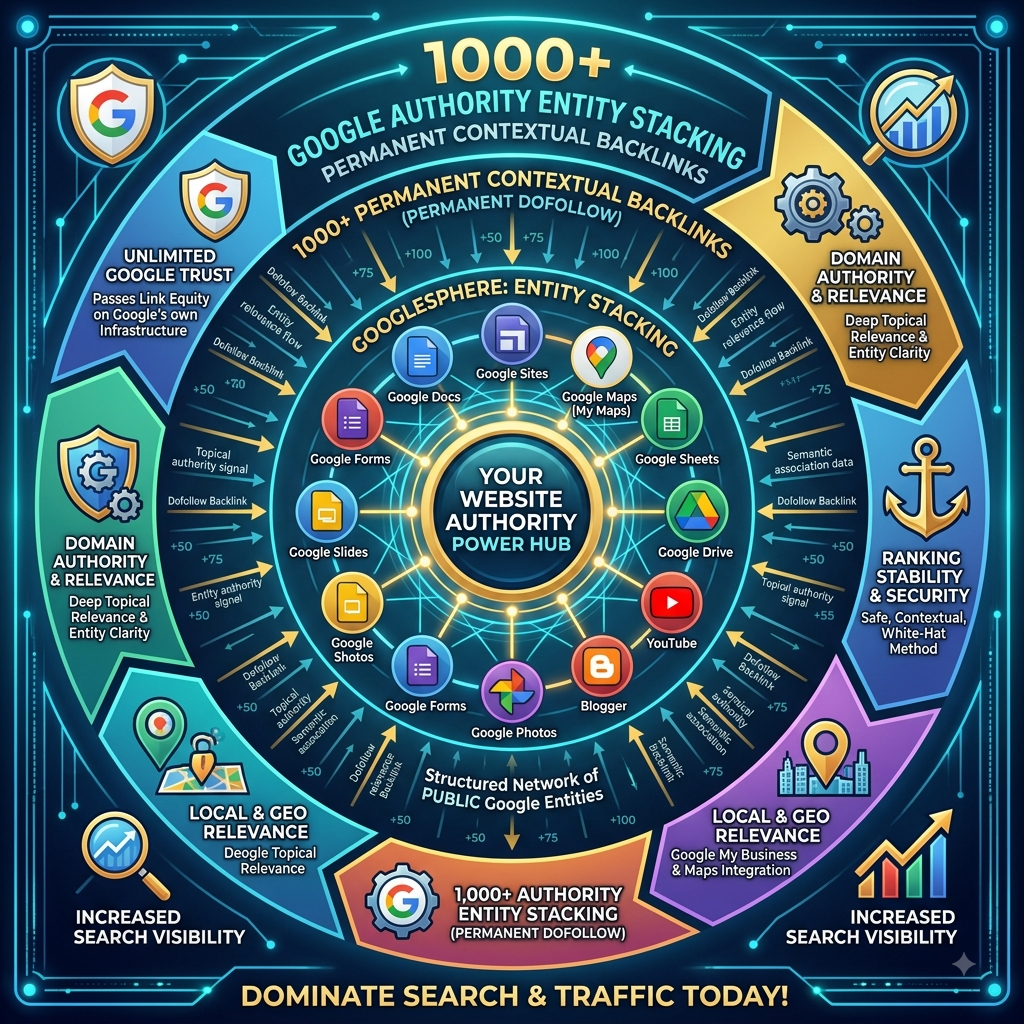
Entity stacking sounds like SEO jargon designed to obscure a simple idea, but the mechanic behind it is straightforward: instead of linking directly from a third-party site to your URL, you build a small chain of properties on platforms Google already trusts implicitly — Google Sites, Docs, Drive, Blogger — and link through that chain before it reaches your target page.
Why the "Google trusts Google" effect matters
Google's own crawlers hit Google-owned properties extremely fast, often within hours rather than the days or weeks a new third-party page might wait for a crawl. A 1,000-link entity stack exploits that: because every intermediate hop sits on infrastructure Google already indexes aggressively, the whole chain — and the target page at the end of it — tends to get discovered and crawled unusually fast.
What it doesn't replace
Entity stacking is a speed and discovery mechanism, not a substitute for genuine topical authority. It shines brightest paired with a slower-building campaign — a contextual backlink package, for example — where the stack gets your page indexed and showing early crawl signal while the higher-authority links mature over the following weeks.
Is it actually white hat?
Yes, and this is worth stating plainly: every property in a proper entity stack is created and owned within Google's own ecosystem. There's no PBN risk, no reliance on a third-party site that could vanish, and nothing that resembles a manipulative link scheme under Google's own guidelines — it's simply using Google's crawl priorities in your favor.
A mistake to avoid: expecting the stack to replace real authority
Because entity stacks index so quickly, it's tempting to treat them as a complete strategy rather than an accelerant. They pass genuine but limited authority — the real value is speed of discovery, not raw ranking power comparable to a high-DA editorial link. Buyers who skip contextual or authority link building entirely and rely only on entity stacks tend to plateau quickly.
What to watch for after ordering
Check Google Search Console's crawl stats and coverage report in the days after your stack goes live — a working entity stack typically shows up as a noticeable uptick in crawl frequency for the target URL within 48 to 72 hours, well before any ranking movement would be expected.
Frequently asked: can entity stacking get my site penalized?
Not when built correctly, since every property lives inside Google's own ecosystem rather than a third-party network Google might later devalue or penalize. The technique carries essentially none of the risk associated with PBNs or link farms — the main failure mode isn't a penalty, it's simply under-delivering on ranking authority if a buyer relies on it as their entire strategy rather than pairing it with genuine contextual or editorial link building.
The bottom line: entity stacking is a genuinely useful, genuinely safe accelerant for a specific problem — slow discovery and crawling — and it's most valuable precisely when paired with a real authority campaign rather than used as a substitute for one. Think of it as compressing the waiting period at the start of a campaign, not as the campaign itself.