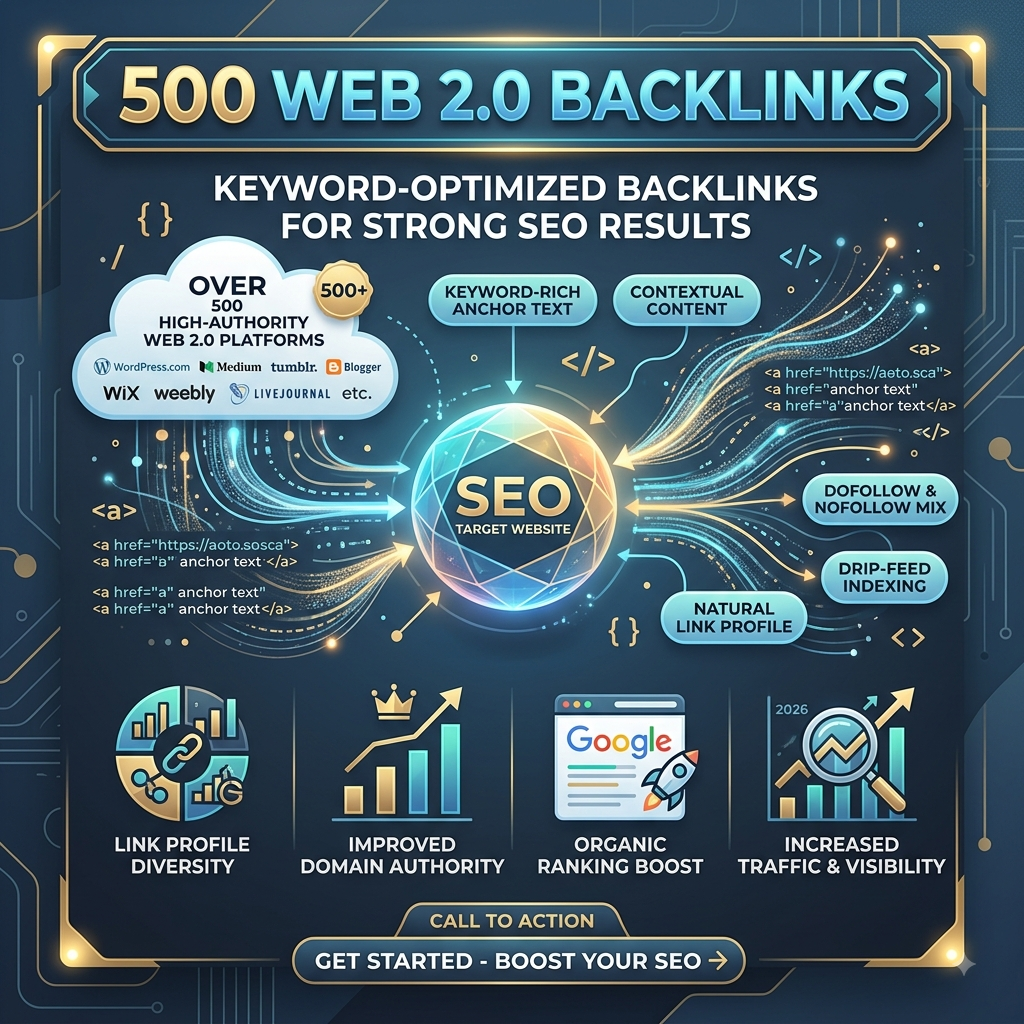
Most Web 2.0 backlink packages treat every placement the same way — a generic property with your link inserted somewhere in generic content. A keyword-optimized approach does something different: it builds the on-page content of every property specifically around your target keywords, so the placement carries topical relevance in addition to raw link authority.
Why keyword-level targeting outperforms generic placement
A Web 2.0 page whose headings, body copy, and anchor text (Ankertext) are all built around "backlinks kaufen für e-commerce," for example, sends a much stronger topical signal for that specific phrase than a generic page with the same link inserted incidentally. A keyword-optimized German Web 2.0 package is built around this precision from the first sentence of every property.
Why this requires a defined keyword list upfront
This approach only works if you already know which specific terms you're targeting — it's not the right tool for a broad brand-awareness campaign with no defined keyword focus. Buyers get the most value from this format when they arrive with a clear, prioritized keyword list rather than a general goal.
Combining precision with breadth
Pair a keyword-optimized layer with a broader German-market backlink campaign for buyers who want both general DACH-region relevance and a precise, keyword-concentrated push on their specific priority terms.
Ein Fehler, den man vermeiden sollte
Providing a vague or overly broad keyword list weakens the precision this package is built around — the more specific and prioritized your target keywords, the more effectively each property's content can be built around them. A short, ranked list of three to five priority terms produces better results than twenty loosely related ones.
What to expect from delivery
Expect properties to go live over roughly a week, built and reviewed individually by native German-speaking contributors. Keyword-level ranking movement is typically the clearest signal to track here, since the campaign is built around specific terms rather than general domain authority.
Häufig gefragt: Wie viele Keywords kann ich in einer Bestellung angeben?
We recommend three to five clearly prioritized target keywords per order rather than a long, unranked list, since concentrating the keyword-optimization effort on a focused set of terms produces more effective, natural-reading content than spreading the same 500 links thin across a dozen loosely related phrases. If you have more than five priority terms, splitting them across multiple smaller orders often performs better than one unfocused large one.
Fazit: Wenn Sie bereits eine klare Keyword-Liste haben, liefert diese Kampagne mehr Präzision als ein generisches Web-2.0-Paket. The extra content-level optimization is what separates a keyword-focused campaign from a generic one, and it's worth the upfront work of defining your priority terms clearly before ordering.